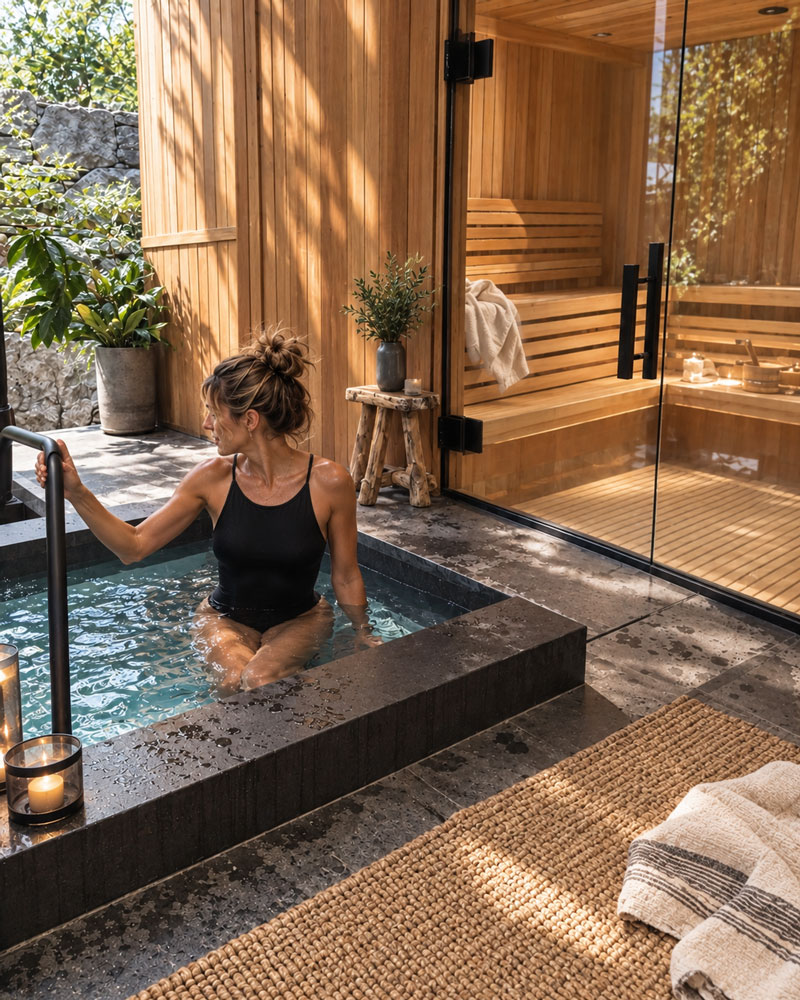
Cold plunges and saunas are having a moment. Scroll through social media and you’ll find claims that they can improve everything from longevity and productivity to mood and metabolic health.
There’s a reason they are so compelling. These practices tap into something fascinating about human biology – our ability to adapt. For those navigating perimenopause, the question becomes: can hot and cold therapies actually support your health during this time of transition?
The answer, as with most areas of women’s health, is nuanced. While interest in these practices has exploded, much of the research has historically focused on men (in fact, the largest study on sauna-bathing was done exclusively in middle-aged men!). This means we need to interpret the science through the lens of female physiology, rather than assuming the same protocols apply equally to women.
Research specifically looking at perimenopause is sparser still. So are cold plunges and saunas worthwhile for women looking to support themselves during perimenopause? Let’s explore some of the science.
The science behind hot and cold exposure: hormesis
One of the key ideas behind both heat and cold exposure is hormesis. Hormesis describes how small, controlled stressors can encourage the body to adapt and become more resilient over time.
Think of it as a workout for your biology. The most powerful and well-established example of hormesis is also one of the least glamorous: exercise.
Strength training, cardiovascular exercise and regular movement create small challenges that support muscle, metabolism, cardiovascular health, mood, cognition and stress resilience. During perimenopause, when changing hormone levels influence many of these systems, exercise remains one of the most valuable tools available.
Cold plunges and saunas are exciting because, like exercise, they may stimulate some of the body’s adaptive pathways too. They offer another way to explore the biology of resilience, alongside everyday habits like exercise that create the strongest foundation.
Cold exposure: a way to boost mood in perimenopause?
Many women who practice cold water exposure report improvements in mood, anxiety and even hot flushes. In a UCL survey of women experiencing menopause, 47% reported improvements in anxiety after cold water swimming, with many also reporting benefits for mood swings, low mood and hot flushes.
Because these women were already cold water swimmers, we can’t separate the effects of cold exposure from other factors like exercise, nature and community. However, the findings align with wider research indicating that cold exposure may influence mood and stress regulation.
A 2023 study found that adults new to cold water immersion experienced increases in positive emotions after just five minutes in 20°C water, alongside changes in brain networks involved in emotion and self-regulation.
This may help explain why some women feel calmer, clearer and more resilient after cold exposure. The key is finding the right dose. Hormesis works through a manageable challenge that encourages adaptation.
Importantly, women do not necessarily need the extreme protocols often promoted online. You may notice that 20°C in the study above is a far cry from the ice-cold baths you may have seen in health documentaries or on your Instagram feed!
Women’s health expert Dr Stacy Sims and cold exposure researcher Dr Susanna Søberg both suggest that temperatures around 14-16°C are sufficient for women to access the potential benefits of cold exposure. For many women, a cool shower, finishing your normal shower with 30-60 seconds of cold water, or a brief dip may be all that’s needed.
Sauna, heat and the menopause brain
Heat exposure has attracted attention for its potential effects on mood, cognition and temperature regulation.
One clinical trial found that whole-body heat treatment improved mood for several weeks in adults with depression, suggesting that heat may influence biological pathways involved in emotional wellbeing. This was not the same as a normal sauna session, and the study was not in perimenopausal women. However, it does suggest that heat might have meaningful effects on mood-related physiology.
Researchers are also exploring whether heat exposure may influence brain-derived neurotrophic factor (BDNF), a protein involved in brain health, learning and memory. This is particularly interesting during perimenopause. Oestrogen plays an important role in brain function and is thought to influence BDNF levels, which may contribute to the changes in focus, memory and mental clarity many women experience.
Exercise remains the best-studied way to support BDNF during menopause, but whether sauna can create similar benefits is an exciting area of research.
Some experts also believe regular sauna use may help improve the body’s internal temperature regulation, which may be relevant for women experiencing hot flushes, though we don’t yet have significant research to back this up.
For women who are new to sauna bathing, starting with 10-15 minutes at a comfortable temperature is a sensible place to begin. Many of the reported benefits in studies are associated with sessions lasting around 15-20 minutes.
Why female physiology matters
One of the biggest limitations of the current evidence base is that women are often underrepresented in research. We know that women tend to perceive cold and begin shivering at higher temperatures than men, and that fluctuations in oestrogen and progesterone may influence how we respond to changes in temperature.
During perimenopause, when hormones fluctuate more widely and unpredictably, your tolerance for heat and cold may shift from one day to the next. A cold plunge that feels invigorating one week may feel unbearable the next.
This is one reason that it’s important to work with your physiology and listen to your body’s signals, rather than following one-size-fits-all protocols.
Why your response will be unique
One of the most important things to remember is that your experience of heat and cold exposure will be individual. Your hormones, sleep, stress levels, current health status and even your genetics all influence how your body responds.
Genes involved in stress resilience, metabolism and heat adaptation, including FOXO3 and UCP1, are just two examples of the many biological factors that may influence your ability to adapt.
This is why your friend may feel transformed by cold water while you may feel completely drained afterwards. Scientific studies can provide valuable insights, but your own experience provides the most valuable data!
Your body is constantly giving you feedback about what supports you, what challenges you and what helps you adapt.
Ask yourself:
- Do I feel calmer or more stressed afterwards?
- Am I sleeping better?
- Has my mood improved?
- Do I feel energised or exhausted?
- Am I recovering well?
Learning to listen to these signals (a.k.a. body literacy) is one of the most valuable skills you can develop during perimenopause.
Foundations first, experiments second
There is something undeniably appealing about these practices. A cold plunge or sauna session feels like a clear, actionable intervention. It gives us something tangible to do in pursuit of better health. Not only this, but it can seem like an exciting or novel ritual to partake in.
But the most important foundations of wellbeing are usually far less exciting. They rarely go viral on social media, they simply work.
Eating enough protein and plant foods, strength training, regular movement, quality sleep, stress management and nervous system support remain some of the behaviours with the strongest evidence for helping women thrive through perimenopause.
While social media rewards health trends, your physiology continues to reward consistent foundations. Hot and cold therapies can be valuable additions, offering another way to support your body’s natural ability to adapt.
However, the ultimate goal should be to understand your own unique physiology and choose the tools that help you feel your best. Perimenopause is an incredible opportunity to become more connected to your body’s signals, and learning to listen to those signals may be the most powerful tool of all.
Finally, it’s important to note that heat and cold exposure are not risk-free, and it’s important to engage in them safely. If you have a history of cardiovascular disease, uncontrolled blood pressure, respiratory conditions or other medical concerns, speak to your GP or healthcare provider before introducing regular heat or cold exposure practices.
Between the podcasts, the protocols and the endless “you have to try this” from well-meaning friends, it’s hard to know what’s actually worth your energy and what’s just noise. A Functional Medicine appointment is designed to give you clarity so you can focus on what matters and put down the rest. We listen to your full story, your symptoms, and what you’ve already tried, then connect the dots and build a clear, personalised plan based on your unique biology.
Explore Functional Medicine Here
Additional information
How do women feel cold water swimming affects their menstrual and perimenopause symptoms? https://journals.sagepub.com/doi/10.1177/20533691241227100?
Cold water immersion impact on mood and interaction between brain networks – https://pmc.ncbi.nlm.nih.gov/articles/PMC9953392/
Heat exposure for depression – https://pubmed.ncbi.nlm.nih.gov/27172277/
Movement and brain health in perimenopause – https://www.sciencedirect.com/science/article/pii/S0378512225005559
Heat exposure and BDNF – https://pubmed.ncbi.nlm.nih.gov/34879921/
Sex differences in cold perception and shivering onset – https://pubmed.ncbi.nlm.nih.gov/30196892/
Influence of ovarian hormones on responses to cold in women – https://pmc.ncbi.nlm.nih.gov/articles/PMC9154773/